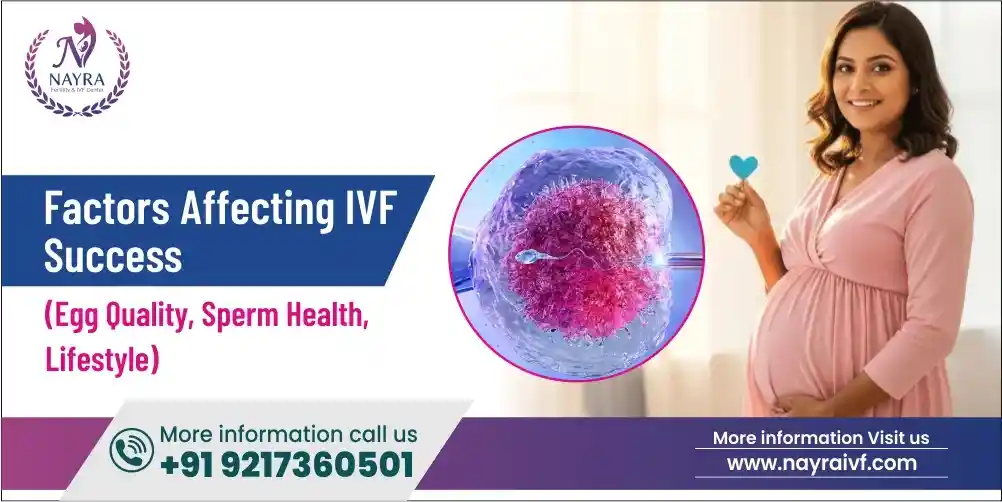
IVF is one of the most effective types of Assisted Reproductive Procedures for couples facing infertility who are unable to get pregnant. Several reasons exist behind why some people conceive sooner than others, even though the procedure is the same for both cases. This is because the success rate of IVF is not a single fixed number and assisted reproductive procedures cannot be answered with a single fixed number. When all the biological and lifestyle factors fit accurately, it leads to positive outcomes. However, out of several factors, the clinic’s infrastructure and fertility specialist expertise play a major role in success. Therefore, if you are looking for the best IVF treatment in Noida, then visit Nayra IVF. Here we have advanced embryology labs and the expertise of Dr. Preeti Singh to ensure a higher IVF success rate.
7 Factors Affecting IVF Success
IVF is a multifactorial infertility treatment that depends on accurate timing and accuracy. All the factors significantly influence the treatment outcomes and successful births. The following are the 7 key factors behind a successful IVF procedure.
Age of the Woman
This is the most crucial factor in the IVF success rate. If a woman is within the 24 to 34 age group, she has the highest likelihood of successful IVF treatment because she is fertile. But everything goes downhill after 35 as their fertility rate decreases.
Quality of Eggs and Sperm
Women’s eggs and men’s sperm are the two most important factors in a healthy pregnancy. But when the quality of either of these two factors degrades, it poses a notable obstacle to successful pregnancy. The quality of an egg is related to the age, genetics, lifestyle, and general health conditions of the woman. Meanwhile, the quality of sperm depends on shape, motility, and count. If there is sperm DNA damage, it also indicates sperm abnormality in an infertile man. However, when fertility specialists during the IVF procedure find an appropriate number of quality eggs and sperm, the chances of egg fertilization and embryo development increase.
Embryo Quality and Laboratory Standards
Embryo quality depends on the efficacy rate of eggs and sperm. When your embryos start to grow and reach the blastocyst stage on day 5 or 6, it states that the embryos have reached the mature stage. Then the embryologist selects the strongest and most viable embryo for potential implantation, and the surplus embryos are frozen for future use. But successful embryo transfer also depends on the clinic’s embryology lab standards. These labs need to maintain proper hygiene along with controlled air and temperature parameters. A skilled embryologist uses advanced systems to monitor every stage of the embryo’s development without causing any disturbance. These labs also need to have stable incubators that will protect the embryo from external interference. In the context of the highest laboratory standards, Nayra IVF offers the best IVF treatment with a focus on successful live births.
History of Previous Pregnancy
If a couple’s previous pregnancies show a potential success rate, they have a higher chance of positive pregnancy outcomes with IVF. However, if their medication history indicates multiple failures in pregnancies and several fertility-related issues, either male or female, then it demands a complex IVF procedure for better results. If there had been miscarriages in previous pregnancies, it might have been related to several problems, such as uterine abnormalities, PCOS, fibroid tumors, ovarian dysfunction, low sperm motility, and, in severe cases, unexplained infertility. So, these issues need to be considered while determining the success rate of the IVF.
Controlled Ovarian Stimulation Protocol
Again, the age of the woman becomes a crucial factor here because ovarian reserve declines with age. At a younger age, when women have high ovarian reserve, this indicates that fertility doctors can retrieve an ample amount of quality eggs during the IVF cycle. A greater number of quality eggs leads to a higher number of embryos. Therefore, this situation pushes the odds that at least one healthy embryo will be extracted for a successful transfer. Based on your current ovarian reserve, fertility specialists design an individualized ovarian stimulation protocol where fertility medications are administered. So, after ovarian stimulation, several mature and healthy oocytes are developed for egg retrieval, resulting in a successful pregnancy. At Nayra IVF, Dr. Preeti Singh carefully adjusts dosages of hormonal medications so that eggs can be developed properly.
Uterine Health and Endometrial Readiness
Now, when your embryo is ready for implantation, the uterine lining (endometrium) should be prepared to continue with the further procedure. The uterine lining should be healthy and thick for proper implantation. If everything fits perfectly, then there is no obstacle to successful implantation in IVF, but the problem arises when fertility doctors identify the presence of fibroids or polyps in the uterus of patients who suffer from a condition called endometriosis. All these can impact the success rate of IVF. So, before embryo fertilization and implantation, ERA tests are conducted to identify uterine health and readiness of the endometrium. These advanced clinical tests help fertility specialists to understand the patients’ reproductive health more precisely. Also, these tests determine the perfect time for embryo implantation, thereby improving overall IVF outcomes.
Lifestyle Factors
The best IVF treatment always prioritizes biological and lifestyle factors equally. That’s why, irrespective of regulating hormonal medications and maintaining advanced laboratory standards, fertility specialists always advise couples to follow a nutritious diet. It has been observed that patients who are underweight or have a higher BMI respond differently to hormonal medications. Therefore, this influences the IVF success rate. If you smoke, drink alcohol, or struggle with prolonged stress, along with irregular meal timings, that also affects reproductive hormones. Studies have shown that if you stop drinking and smoking at least 3 months before the IVF treatment procedure, it increases your chance of getting pregnant.
Conclusion
At the beginning of IVF, you may feel confused about what works best for you and what does not. Therefore, a proper understanding of the above-stated factors hailing from eggs, sperm, and embryo quality, uterine health, ovarian reserve, age of the woman, and lifestyle factors guide you to the accurate direction, increasing your chance of an IVF success rate.
For the best IVF treatment in Noida,fix an appointment with our experienced fertility specialist, Dr. Preeti Singh, at Nayra IVF today.